.JPG.opt840x559o0,0s840x559.JPG)
General History of RugbyWilliam Webb Ellis and the Origins of RugbyMost rugby players have at one time or another heard the classic story of rugby's beginning. In 1823, during a game of soccer at Rugby School in England, 16 year old William Webb Ellis, in fine disregard for the rules, picked up the ball and ran with it. After William's display it was so obvious to his classmates the genius of that move that soon the whole school adopted the new rules and word quickly spread. And so the game of rugby was born. Unfortunately the legend of William Webb Ellis is most likely just that- a legend. Most scholars agree that this story is probably too good to be true and point out that games that involved running with the ball had existed centuries earlier. While it is true that such games did exist for centuries, their may be a kernel of truth to the William Webb Ellis legend. As far as most historians can tell, the earliest form of football with much similarity to rugby as we know it today, did originate at Rugby School around Ellis's time. Whether he was the actual creator of the game or the game simply evolved into something like the modern game during his time is still a point for debate. Most probable is the slightly different version of the legend that the English Rugby Union relates. According to the English Rugby Union, the type of football played at Rugby School in Ellis's time was not soccer, but a game with a mixture of both soccer and rugby rules. Handling the ball was prohibited unless the ball was airborne, when the player was permitted to catch it. After catching the ball he would stand still, as did all the other players, and had the option of kicking it wherever he chose, or placing it on the ground and kicking for goal. It is also very important to remember that in those days at English Public Schools, students often developed their own rules for the games of football they played on the spot as there was very little official refereeing. So it is possible that William Webb Ellis did in fact pick up the ball and run with it during an impromptu game of football, which set an example for others. But one thing does remain, it is highly dubious that rugby originated from soccer as we know it today. It is far more likely, and most historians tend to agree, that both rugby and soccer developed roughly side by side as rules became more formalized and documented. Whatever the case, the story of William Webb Ellis is too good not to be held on to and cherished. William Webb Ellis has an official headstone on the grounds of Rugby School with the following inscription: "This stone commemorates the exploit of William Webb Ellis who with a fine disregard for the rules of football, as played in his time, first took the ball in his arms and ran with it, thus originating the distinctive feature of the Rugby game A.D. 1823" By the 1840s running with the ball had become the norm, and by the 1870s rugby clubs had sprung up all over England and in the colonies. But just as it was during the earliest days at the public schools, different rules were being used by different clubs with no official codification of the rules being laid down. To try and remedy this situation and provide a more uniform set of laws, a meeting was held in January 26, 1871, attended by the representatives of 22 clubs. It was at this meeting that the Rugby Football Union was founded. The meeting was called by Edwin Ash, then secretary of the Richmond Club. He sent a letter to the newspapers which stated: "Those who play the rugby type game should meet to form a code of practice as various clubs play to rules which differ from others, which makes the game difficult to play". Following the founding of the Rugby Football Union, a committee was formed consisting of three ex-Rugby School pupils who were invited to formulate a set of laws to help govern and unify the game. By June 1871 they had accomplished their task. Soon after the Scottish members of the Union challenged the English to a match. This was by all accounts the first international match between England and Scotland, perhaps between anyone, and took place at Raeburn Place in Edinburgh on March 27, 1871, resulting in a win to Scotland. The "Great Schism" and the Start of Rugby LeagueThe rugby football union at this time believed strongly in maintaining the games amateur status. Despite this commitment, in 1893 reports of some players in the north of England receiving payments for playing reached the RFU, and it attempted to obtain evidence. The Union set up an inquiry into the matter, but was warned that if the club involved was punished, all the chief clubs in Lancashire and Yorkshire would secede from the Rugby Football Union. The inquiry went ahead and the club concerned was suspended. Two general meetings resulted at which the Northern Unions lobbied for the right to pay player "broken time" wages to help cover any lost wages players incurred by skipping work to play in matches. It is important to note that many of the Northern Union clubs had a strong mining and blue collar constituency and lost pay was a serious concern for them. The Northern Union's request was denied and in August 1895 twenty two of the northern clubs seceded from the Rugby Football Union and formed the Northern Union, later to become known as the Rugby League. The Rugby League quickly adopted rules to make the game more attractive to spectators in order to draw crowds to help pay the men's broken time wages. This is where the reduction of players to 13 came into effect as well as the move to a multiple downs style of play. As a result, Rugby League is very distinctive from Rugby Union in both appearance and strategies employed. Rugby Union Becomes ProfessionalAs the years wore on, the IRB and the Rugby Football Union clung to their amateur roots and traditions tightly, but there were growing cries from around the globe to turn professional. Ironically many of these reasons shadow the reason the Northern Union split away in the first place, namely increased demands on players time as well as increased media attention on the sport and revenues generated as a result. Many felt it was simply unfair to have so much money generated and the players receive none of it in spite of all of their sacrifices for club and country. Along with this was a growing "hidden professionalism" in Rugby Union. While open air payments were unlikely, it became clear that most players were receiving a number of perks for playing such as houses, cars, and other under the table deals. Realizing that the sport needed to move to a professional model if it was to remain intact, the IRB and RFU accepted professionals in Rugby Union in August 1995. |
Basic Rules of RugbyAlthough to the naked eye a game of Rugby Union can appear like a carefully orchestrated riot, this is not actually the case. There are some rules that govern and bind the orchestrated riot to make it, perhaps surprisingly to those new to the sport, very methodical and tactical when played properly. Below is a quick overview of the basics of Rugby Union. To view a complete PDF copy of the 2008 IRB Laws on the Game for 15s click here, U19 variations click here, or for 7's click here. You can purchase a hard copy of the laws for you or your team here. Duration: A rugby match is played over 80 minutes, split into two 40-minute halves generally with a 10 minute half time break. Number of Players: Each team has 15 players who assume various positions, which play critical parts in the team's play. Eight players make up the forwards or 'pack' (roughly similar to the linemen and line backers in American football) and seven players make up the backs (roughly similar to the backs and "skill positions" in American football). To learn about forwards and backs as well as each individual position click here. How to Play: The ball can be moved by carrying it in the hands, or kicking at any time during play, but under no circumstances can the ball be passed or made to go forward by the ball carrier other than by kicking the ball. If the ball is hit or passed forward without it being kicked, it is called a 'knock on' and is an infraction which results in a scrum to the opposition. A scrum is used to restart in a number of situations and involves each team's forwards coming together, binding together by the shoulders over the 'mark' and trying to hook the ball back to their team's side once the ball is placed in the channel. This is similar to a tip off in basketball with each team having a chance at winning the ball. When the ball is being kicked during a kick off or 22 meter drop out it must be drop kicked. If a ball is kicked or taken out of bounds the ball is restarted by a lineout. This is similar to the throw-in in soccer and works on the same principle. If a team is awarded a penalty (meaning the other team committed a penalty against them) they have the same three options at every penalty. They can either:
In any of these instance, the guilty team must retreat 10 meters from the spot of the foul. The aim of the game is, you guessed it, to score as many points against your opponent as possible while conceding as few as possible. Points are scored by the following methods:
The team that has been scored on always restarts play by kicking to the team that scored the points (except in sevens rugby where the team that scores kicks to the team that was scored on). 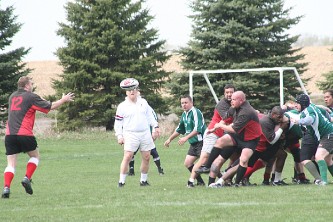 Rugby is played by men with odd shaped balls. The pub is as much a part of rugby as is the playing field. |